
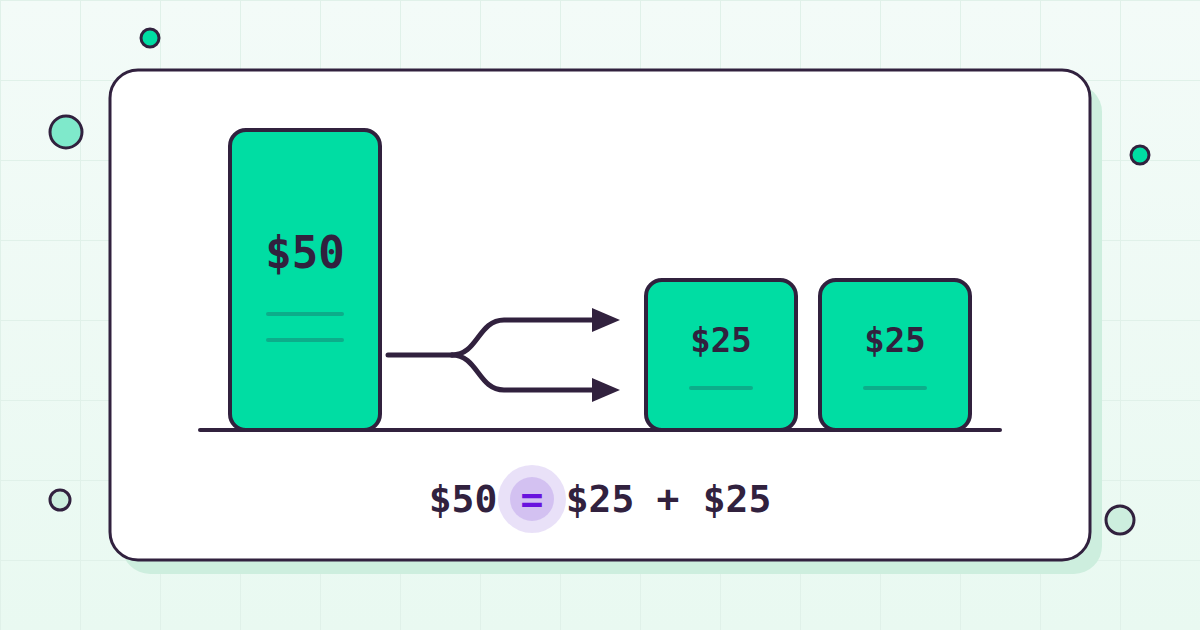
Mutual fund splits are real – they just don’t come up very often. They work almost exactly like stock splits: the share count changes, the price per share changes, and the total value of what you own doesn’t change at all. The one twist is how mutual funds are priced, and that twist is why fund splits are so quiet when they happen. Let me explain.
What are stock splits?
A stock split is when a company divides its existing shares into more shares – or fewer, in the case of a reverse split. In a 2-for-1 split, every share becomes two: the share count doubles and the price per share halves. If you held 100 shares at $50, you now hold 200 shares at $25. Same $5,000 either way.
Nothing about the company itself changes – a split is cosmetic. It changes the multiplier, not the pie.
Why do companies issue stock splits?
Usually because the per-share price has climbed to a big number, and a lower price feels more accessible to investors. A $1,000 stock and a $100 stock can represent the exact same value, but the $100 one feels easier to buy (we’re all a little susceptible to price psychology). A reverse split is the mirror image: fewer shares at a higher price per share, typically after a stock has fallen to an uncomfortably low level.
Either way, the value of the business isn’t affected. Only the sticker changes.
Why do mutual fund splits happen?
A mutual fund can split its shares the exact same way. In a 2-for-1 fund split, the NAV (net asset value) per share is halved and the number of shares you hold is doubled. Your account value is untouched, and so are the fund’s holdings – the same portfolio is sitting there the day after the split as the day before.
Why bother? Occasionally a fund’s per-share NAV climbs to a high number, and the fund would like it to sit at something more approachable. That’s the whole reason. It changes nothing about the value of your investment or the securities the fund owns.
The key difference from stocks: mutual fund shares don’t trade during the day at fluctuating market prices. They’re priced at NAV, calculated once daily after the market close. So when a fund splits, there’s no intraday market reaction to watch – the NAV and share count are simply adjusted administratively, and the next day’s NAV shows up at the new, lower level. Quiet and clean.
How often does this happen? Rarely. Fund splits are a real corporate action, but you can go a long time without seeing one – which is exactly why they catch people off guard.
Where can I find mutual fund split data?
This is where rarity becomes a data problem. If your price history misses a 2-for-1 fund split, your chart shows a 50% overnight crash that never happened – and anything you compute on top of it (returns, backtests, alerts) inherits the error. Any mutual fund price series you rely on should be adjusted for splits and for distributions.
Tiingo’s end-of-day price data covers mutual funds with NAV and price history adjusted for splits and distributions, as part of the 80,000+ assets we cover (as of July 2026). The free Starter plan is $0 – we’ve been making high-end data accessible since 2014, and catching the quiet corporate actions is part of the job.
So if a fund chart ever looks like it fell off a cliff overnight, check for a split before you panic. And if you’d like data where that check is already done for you, come say hi at Tiingo.