
The Shenzhen Stock Exchange is China’s second-largest stock exchange by market capitalization, and it is the market most closely tied to the country’s innovative, high-growth companies. As of July 22, 2026, roughly 2,900 companies list on the SZSE, with a combined market cap of RMB 43.055 trillion (about $6.35 trillion). For anyone looking at Chinese A-shares, understanding how the SZSE actually works is key – and a lot of what is written about it in English is years out of date.
So we put together a comprehensive guide covering every aspect of the Shenzhen Stock Exchange. We’ll walk through its boards, its indices, its trading mechanics, stock price data, regulation, ESG initiatives, and international access. One habit we’ll keep throughout: every market figure carries its as-of date. The SZSE’s total market cap moved roughly 12.6% in eight weeks this year (RMB 49.26 trillion on May 27, 2026 to RMB 43.05 trillion on July 22, 2026), and an undated number in a fast-moving market is worse than no number. Context in markets is everything.
TL;DR: Key Takeaways
- The SZSE began trading on December 1, 1990, and was built to support the Shenzhen Special Economic Zone – today it is the home market for China’s tech and high-growth companies.
- It runs two boards: the Main Board and ChiNext. The old SME Board was merged into the Main Board on April 6, 2021 (many guides still get this wrong).
- About 2,900 listed companies and RMB 43.055 trillion (~$6.35 trillion) in market cap as of July 22, 2026.
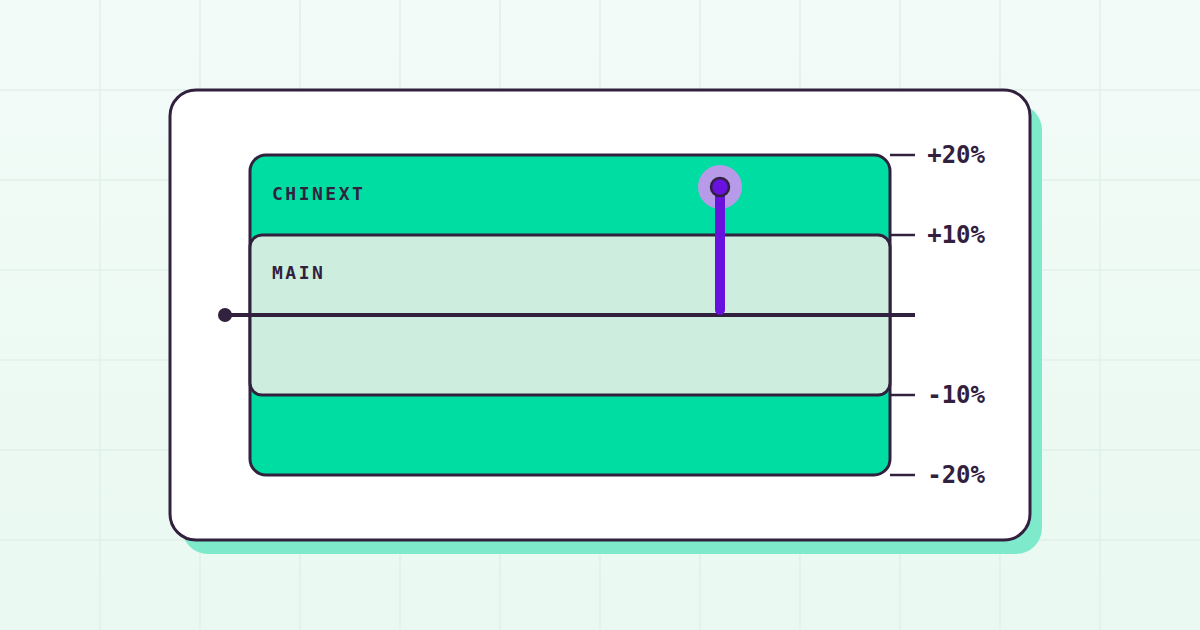
- Daily price limits are ±10% on the Main Board and ±20% on ChiNext, with no limit during a new listing’s first 5 trading days.
- A major trading-rule overhaul took effect July 6, 2026: an after-hours fixed-price session (15:05-15:30) for all A-shares and ETFs, ST/*ST limits widened to ±10%, and a market-maker scheme on ChiNext.
- Foreign investors reach the SZSE through Shenzhen-Hong Kong Stock Connect (launched December 5, 2016) and the QFI program – real access, but channeled.
- Regulatory reform has been constant: full registration-based IPOs since 2023, tougher delisting rules since late 2024, and a ChiNext listing reform in April 2026.
- Tiingo covers Chinese A-shares as part of our end-of-day stock price data, alongside US equities, ETFs, and mutual funds.
The SZSE’s Journey: From Inception to Innovation Hub
The Shenzhen Stock Exchange (SZSE) officially began trading on December 1, 1990. Here’s a detail that surprises people: the Shanghai Stock Exchange was established first, on November 26, 1990, but its first trading day was December 19. Shenzhen actually traded first, by eighteen days. Both exchanges were born out of China’s broader economic reforms, but the SZSE had a specific mandate – supporting the growth of the Shenzhen Special Economic Zone, the experimental district next to Hong Kong where much of modern Chinese manufacturing and tech grew up.
From that small start, the SZSE has grown into one of the world’s largest stock exchanges. We won’t pin an exact global rank on it – the league table shifts with every FX move and rally, and most published rankings are stale – but the dated numbers speak for themselves: RMB 43.055 trillion (~$6.35 trillion) in market cap across roughly 2,900 companies as of July 22, 2026. This holds especially true for high-growth companies: Shenzhen is where China’s entrepreneurial economy lists.
Milestones That Shaped the SZSE
A few dates explain most of the modern SZSE:
- October 30, 2009: ChiNext launches – Shenzhen’s growth board for innovative, early-stage companies.
- August 24, 2020: The registration-based IPO reform goes live on ChiNext, and daily price limits there widen to ±20%.
- April 6, 2021: The SME Board is merged into the Main Board (CSRC approval came February 5, 2021; the announcement March 31, 2021). Two boards, not three, ever since.
- 2023: The registration-based IPO system extends market-wide, replacing the old approval-based regime.
- April 10, 2026: The CSRC issues ChiNext reform opinions adding a fourth listing standard that supports high-quality unprofitable innovative companies.
- July 6, 2026: The biggest trading-rules overhaul in years takes effect, including an after-hours session for all A-shares.
SZSE vs. Shanghai Stock Exchange: A Distinct Focus
The Shenzhen Stock Exchange and the Shanghai Stock Exchange are both central to China’s capital markets, but they serve different roles. Shanghai leans toward larger, well-established companies – think banks, energy, and industrial champions – plus its STAR Market for strategic tech. Shenzhen tilts toward innovation, technology, and growth-stage businesses, especially through ChiNext.
The dated numbers make the split concrete. The SSE listed 2,312 companies worth RMB 64.635 trillion (~$9.53 trillion) as of July 23, 2026. The SZSE listed about 2,900 companies worth RMB 43.055 trillion (~$6.35 trillion) as of July 22, 2026. Shanghai is bigger by value; Shenzhen lists more companies. That is exactly what you’d expect from a market of younger, smaller, faster-growing names.
That growth tilt cuts both ways. ChiNext’s ±20% daily price limit is double the Main Board’s, and sectors like biotech, fintech, and green energy simply move more. Higher growth potential, higher volatility – the SZSE offers both, and it’s worth going in with eyes open.
One more thing many guides omit: China has three exchanges now. The Beijing Stock Exchange (BSE) began trading on November 15, 2021, reformed out of the NEEQ “New Third Board” selected tier. It is much smaller – roughly 313 companies and around RMB 0.94 trillion in market cap as of mid-2026 (press-derived estimates) – and focuses on innovative small and mid-sized enterprises, with ±30% daily limits and 920-prefix tickers. Any comparison of Chinese venues should at least name it.
Decoding the Shenzhen Stock Exchange’s Market Structure in 2026
The Shenzhen Stock Exchange runs two boards: the Main Board and ChiNext. If you’ve read that it has three, that guide predates April 6, 2021, when the SME Board (small and medium enterprise board) was merged into the Main Board – 461 Main Board companies and 1,002 SME Board companies became one combined board. A word of warning for researchers: SZSE’s English homepage still shows a legacy “SME Board” tab. That’s stale site furniture, not a live market segment – SZSE’s own market data has no SME line item today.
Ticker prefixes tell you where a stock lives: 000 and 001 are Main Board A-shares, 002 and 003 are the ex-SME names (now Main Board), 300 and 301 are ChiNext, and 200 marks B-shares.
About those B-shares: they are a vestige of the era before foreign investors had good channels into A-shares. Shenzhen’s B-shares are quoted in Hong Kong dollars (Shanghai’s are in US dollars – guides frequently state this backwards), settle on T+3, and have been open to mainland individuals with foreign-currency accounts since February 2001. Just 38 B-share listings remain on the SZSE, worth RMB 36.55 billion – 0.08% of the exchange’s market cap as of July 22, 2026. A rounding error, but a fun piece of history.
For tracking all of this, the SZSE Component Index is the market’s headline barometer – more on it below.
The Main Board: Cornerstone of the SZSE
The Main Board carries Shenzhen’s most established companies – 1,493 A-share listings worth RMB 24.94 trillion as of July 22, 2026 – and it’s the segment most often used as a benchmark for the market’s overall health.
Since 2023, listings run through the registration-based IPO system: companies must meet financial and disclosure thresholds, but the process is standardized and exchange-led rather than discretionary approval by the regulator. Main Board stocks trade with a ±10% daily price limit, which keeps day-to-day moves more contained than on ChiNext.
The Main Board’s listing requirements are stricter than ChiNext’s. It’s the venue for companies with established operating histories, and that structure is a meaningful part of investor protection.
ChiNext: Powering Innovation and Growth
The ChiNext Board launched on October 30, 2009, and it is the reason “Shenzhen” and “innovation” appear in the same sentence so often. It focuses on technology, biotech, and renewables companies, and it has grown into a genuinely large market: 1,399 A-share listings worth RMB 18.08 trillion as of July 22, 2026.
ChiNext pioneered the registration-based IPO system in August 2020, which streamlined listings while keeping disclosure requirements comprehensive. Its listing standards are more flexible than the Main Board’s – that’s the design – and in 2026 they got more flexible still. On April 10, 2026, the CSRC issued ChiNext reform opinions adding a fourth listing standard that explicitly supports high-quality unprofitable innovative companies, with SZSE’s supporting rules following on April 24, 2026. This is a genuinely significant shift: pre-profit innovators no longer need to route around Shenzhen to go public.
ChiNext trades with rules tuned for its volatility profile: a ±20% daily price limit (since August 24, 2020), a maximum order size of 300,000 shares, and a suitability gate for domestic retail investors of RMB 100,000 in assets plus 24 months of trading experience. And since July 6, 2026, ChiNext has a market-maker scheme to support liquidity, with block-trade confirmations moved to real time.
SZSE Component Index: Barometer of Market Performance
The SZSE Component Index (code 399001) is the exchange’s headline benchmark. It tracks 500 constituents – expanded from the original 40 back in 2015, so if a guide tells you “40 stocks,” it’s a decade stale – selected across sectors to represent the broader market.
The index is weighted by free-float adjusted market capitalization, meaning only shares actually available for public trading count toward a company’s weight. And here’s a detail we care about as a data company: it is calculated by Shenzhen Securities Information Co., a subsidiary of the exchange – not by China Securities Index Co. (CSI), which runs the SSE Composite and CSI 300. Attribution matters when you’re chasing down methodology documents.
Don’t confuse the Component Index with its siblings:
| Index | Code | Constituents | Notes |
|---|---|---|---|
| SZSE Component | 399001 | 500 | Free-float weighted; base 1994-07-20 = 1000; expanded from 40 to 500 in 2015 |
| SZSE Composite | 399106 | All SZSE Main Board + ChiNext stocks | Broad all-share index; base 1991-04-03 = 100; distinct from the Component Index |
| ChiNext Index | 399006 | 100 | 20% single-name weight cap; base 2010-05-31 = 1000 |
All three are calculated by Shenzhen Securities Information Co., and all are periodically reviewed and rebalanced so they keep representing the market as it actually is.
How Trading Works: Hours, Price Limits, and Settlement
The mechanics are where most English-language guides go stale, so let’s lay them out precisely. All times are China Standard Time (UTC+8, no daylight saving).
| Session | Time |
|---|---|
| Opening call auction | 09:15-09:25 (no cancellations 09:20-09:25) |
| Continuous trading, morning | 09:30-11:30 |
| Lunch break | 11:30-13:00 |
| Continuous trading, afternoon | 13:00-14:57 |
| Closing call auction | 14:57-15:00 |
| After-hours fixed-price session | 15:05-15:30 (all A-shares and ETFs, since July 6, 2026) |
Daily price limits are computed off the previous close: ±10% on the Main Board, ±20% on ChiNext, and ±10% for main-board ST and *ST (special treatment) stocks since July 6, 2026, when the old ±5% band was widened. Newly listed stocks have no price limit for their first 5 trading days, then adopt the normal band. The board lot is 100 shares for buys (odd lots may only be sold, in a single order), the tick size is RMB 0.01 for stocks and RMB 0.001 for ETFs, and stamp duty is 0.05%, charged to sellers only – halved from 0.1% on August 28, 2023.
Now, settlement – and this deserves precision, because “China is T+1” is one of the sloppiest lines in finance writing. China’s actual model is securities on T, funds on T+1:
- Securities settle same-day. ChinaClear credits shares to your account before 18:00 on trade date.
- Cash settles on a net basis on T or T+1.
- The famous “T+1” is a trading restriction, not a settlement cycle: shares bought today cannot be resold until tomorrow. No intraday round trips in A-share equities.
- Proceeds from a same-day sale can be reused immediately to buy other securities – they just cannot be withdrawn until T+1. Capital recycles intraday; specific share lots do not.
- The no-day-trading rule is an A-share equity rule, not market-wide: ETFs, LOFs, bonds, and repos all permit intraday T+0 round trips.
The July 2026 Trading-Rule Overhaul
On April 24, 2026, the Shenzhen, Shanghai, and Beijing exchanges jointly published revised trading rules, effective July 6, 2026. For the SZSE, four changes matter most:
- After-hours fixed-price trading extended to all A-shares and ETFs (it was previously a STAR/ChiNext feature). From 15:05 to 15:30, orders execute at the day’s closing price, matched by time priority – limit orders only, 100 to 1,000,000 shares, with unfilled orders voided at day’s end.
- Main-board ST/*ST price limits widened from ±5% to ±10%.
- A market-maker scheme on ChiNext, supporting tighter, deeper quotes on the growth board.
- ChiNext block-trade confirmation moved to real time.
If your trading calendar or data pipeline still assumes Chinese equities go quiet at 15:00, it’s time to update it.
How the SZSE Is Regulated
The regulatory landscape of the Shenzhen Stock Exchange is shaped by China Securities Regulatory Commission (CSRC) oversight, the exchange’s own frontline rulebook, and a steadily expanding set of cross-border arrangements. The last few years have brought real structural change – registration-based IPOs, tougher delisting standards, and formal rules for algorithmic trading.
CSRC’s Role in Shaping the SZSE
The CSRC is the backbone of Chinese securities regulation. It sets listing standards and trading-rule frameworks, monitors markets, runs compliance investigations of listed companies, and drives market reform. The registration-based IPO system – piloted on ChiNext in 2020 and extended market-wide in 2023 – was a joint CSRC-exchange project, and so was the 2026 trading-rules overhaul.
The CSRC also anchors risk management: monitoring abnormal trading activity, penalizing market manipulation, and setting the frameworks (like the programmatic-trading rules below) that keep fast markets orderly.
Recent Regulatory Reforms
The SZSE is young compared to most major global exchanges, and its rulebook is still actively evolving. The recent reform record, dated:
- April 12, 2024: The State Council issued new “Nine Guidelines” for capital markets – only the third such framework, after 2004 and 2014 – emphasizing listed-company quality and investor protection.
- October 30, 2024: Delisting rules tightened. The main-board market-cap threshold rose from RMB 300 million to RMB 500 million, and the revenue floor for loss-making companies rose from RMB 100 million to RMB 300 million. Par-value delisting still triggers after 20 straight closes below RMB 1.
- Enforcement followed: 30 A/B-share companies were delisted across China in 2025 (6 voluntarily), and 21 more were delisted or locked in for delisting by early June 2026.
Stricter exits plus streamlined entries – that’s the shape of the reform: make it easier for good companies to list and harder for hollowed-out ones to linger.
Cross-Border Regulations
International participation in the Shenzhen Stock Exchange has been opened up in deliberate stages. The two main channels today are the QFI program (the merged successor to QFII and RQFII) for institutions investing directly, and Stock Connect for trading through Hong Kong. Foreign ownership limits in various sectors have also been relaxed in stages over the years.
We cover both channels in depth in the international connectivity section below – the short version is that access is real, growing, and channeled through defined pipes rather than fully open.
Safeguarding Investors: Protection Mechanisms
The SZSE, alongside the CSRC, runs several layers of investor protection. Real-time surveillance monitors trading for suspicious patterns. Disclosure requirements oblige listed companies to publish updates on their financial condition and any developments that could move their stock – on an equal basis for all investors. And the exchange puts real effort into investor education, which matters in a market with heavy retail participation.
The suitability gates are part of this philosophy too: requiring RMB 100,000 plus 24 months of experience before domestic retail investors trade ChiNext is a deliberate speed bump between newer investors and the most volatile board.
Circuit Breakers and Trading Halts
China’s primary cooling-off mechanism is the daily price limit – the ±10% and ±20% bands we covered above, computed off the previous close. When a stock hits its band, it can’t trade beyond it for the rest of the day. That’s the brake.
For newly listed stocks trading without a limit in their first 5 sessions, a volatility interrupt applies instead: a move of ±30% or ±60% versus the opening price triggers a 10-minute halt, with trading resuming via call auction. Individual stocks can also be halted pending material announcements.
The intent behind all of it is the same: give the market a moment to breathe and price information deliberately, rather than in a panic cascade.
Regulatory Body Responsibilities
Here’s the quick rundown of who does what.
Regulatory body: CSRC
- Sets listing standards and regulatory frameworks for SZSE-listed companies
- Oversees market reforms (registration-based IPOs, delisting rules, trading regulations)
- Enforces securities laws and penalizes violations
Regulatory body: SZSE
- Monitors daily trading operations and runs frontline market surveillance
- Implements and administers trading rules
- Supervises listed-company compliance and disclosure
Regulatory body: Local government
- Promotes local and regional economic growth
- Supports market development in the Shenzhen Special Economic Zone
- Champions Shenzhen’s role as a technology and finance hub
Embracing the Future: Technological Advancements
Exchanges are technology companies at their core, and the SZSE has kept investing in its market plumbing. The clearest recent evidence is structural: adding an after-hours trading session for every A-share and ETF, moving ChiNext block-trade confirmation to real time, and standing up a market-maker program – none of that happens without serious systems work underneath.
Next-Generation Trading Platforms
Modern markets demand speed, reliability, and scale, and the SZSE’s trading systems are built for high-volume, low-latency matching. For algorithmic strategies, the delay between order placement and execution matters enormously, and exchange infrastructure has evolved to serve that demand.
The user-facing side has evolved just as fast – electronic and mobile access mean investors across China (and through Connect, across the world) interact with the SZSE through screens, not trading floors. The result is a market that handles enormous retail and institutional flow simultaneously.
AI and Big Data: Revolutionising Market Intelligence
Surveillance is where data technology earns its keep at an exchange: monitoring millions of transactions to flag unusual patterns and possible manipulation, fast enough for regulators to act.
This is no longer just an aspiration – it’s codified. The CSRC’s programmatic-trading provisions took effect on a trial basis on October 8, 2024, and the exchanges’ implementation rules followed on July 7, 2025, creating a formal regime for algorithmic and high-frequency trading: registration, reporting, and monitoring. If you run systematic strategies in China, this rulebook is required reading.
Blockchain: Exploring New Frontiers
Like exchanges worldwide, the SZSE’s ecosystem has explored distributed-ledger technology for areas like record-keeping and post-trade processing, where tamper-resistant records and automation are genuinely attractive properties. We’d characterize this as exploration rather than production reality – worth watching, not yet something that changes how you trade.
Innovation Roadmap: Pilot Projects and Future Plans
The pattern of Chinese market reform is consistent: pilot on one board, evaluate, then extend. Registration-based IPOs started on ChiNext in 2020 before going market-wide in 2023; after-hours trading ran on the growth boards before extending to all A-shares in 2026. It’s a genuinely sensible way to ship changes to a live market (we’re engineers – we appreciate a good staged rollout), and it tells you how future innovations will likely arrive: somewhere small first.
Expanding Horizons: International Connectivity
The Shenzhen Stock Exchange has become steadily more reachable for global investors through Stock Connect, the QFI program, and cross-border product listings. None of these make China’s market fully open – access is channeled – but the channels are real and they keep widening.
Stock Connect: Bridging Markets
The Stock Connect program is the workhorse of international access. It lets global investors trade eligible mainland Chinese stocks through the Hong Kong Exchange (HKEX) – no mainland brokerage account, no direct market access setup. Shenzhen-Hong Kong Stock Connect launched on December 5, 2016 (two years after the Shanghai link), and ETFs were added to the scheme on July 4, 2022.
The mechanics worth knowing, precisely:
- No aggregate quota. Shanghai’s was abolished on August 16, 2016, and the Shenzhen link never had one. What remains is a daily net-buy quota of RMB 52 billion per Northbound link (RMB 42 billion Southbound) – and you can always sell, regardless of quota.
- Northbound ChiNext access is limited to institutional professional investors. Retail investors abroad can trade Shenzhen Main Board names through Connect, but not the growth board.
- Northbound orders are limit orders only.
- The flow data changed in 2024. Real-time Northbound turnover stopped being disseminated around May 2024, the real-time quota balance now displays only when it falls below 30%, and Northbound shareholding data moved to a quarterly schedule from August 19, 2024. If an older guide tells you to “watch daily northbound flows,” that feed no longer exists – a good reminder to check the vintage of any China-market advice you read.
Future Connections: Expansion Plans
The honest way to predict where access goes next is to look at how it has expanded so far: the Shanghai link in 2014, the Shenzhen link in 2016, ETFs added in 2022, and QFI streamlining in 2025. Each step widened the pipe without removing the pipe. We’d expect the same pattern going forward – more eligible products and smoother operations – rather than a single dramatic opening. Alignment of trading and settlement conventions with international practice remains the long-term project underneath it all.
QFII and RQFII: Attracting Global Capital
A correction to start: QFII and RQFII no longer exist as separate schemes. Investment quotas were abolished in May 2020, and the two programs merged into a single QFI regime effective November 1, 2020. QFI lets approved foreign institutions invest directly in China’s domestic markets – stocks, bonds, and a widening set of derivatives – complementing Stock Connect with a direct channel.
And the regime keeps improving. On October 27, 2025, the CSRC published a two-year QFI optimization plan: application approvals cut to 3-5 working days, ETF options available for hedging from October 9, 2025, and access widened to 107 futures and options contracts. For institutions that found the old QFII paperwork daunting, this is a very different program than the one they remember.
Sustainable Future: ESG and Responsible Investing on the SZSE
As part of its investment in the future, the Shenzhen Stock Exchange has promoted environmental, social, and governance (ESG) practices among its listed companies. Together with China’s broader green-finance push, the goal is a market where sustainability information is disclosed, comparable, and priced.
Green Bonds: Financing a Sustainable Future
Green bonds fund projects with environmental benefits – renewable energy, clean transportation, pollution prevention – and they play a meaningful role in financing China’s transition toward a lower-carbon economy. Credibility is the whole game with labeled bonds: issuers are expected to meet environmental standards and document the use of proceeds, so investors can trust the “green” in the name.
ESG Reporting: Enhancing Corporate Transparency
Transparency is central to market health, and ESG reporting is part of the disclosure picture. Listed companies are encouraged to address environmental impact and social responsibility in their reporting, with both qualitative and quantitative data so investors can actually compare across companies rather than wade through marketing language.
Sustainable Investment Products: Meeting Investor Demand
Demand for sustainable investment products has grown in China, and the product shelf has grown with it: ESG-themed index funds and ETFs tracking companies with strong ESG performance, and green funds focused on environmentally oriented businesses. As with any themed product, the methodology matters more than the label – read what the index actually screens for.
Shaping Corporate Strategies: The ESG Influence
ESG considerations increasingly shape how listed companies operate, from climate-related risk management to governance standards. Investors, in turn, increasingly use ESG criteria as a screen. Whatever your view on the ESG label itself, the underlying shift – more disclosure, more comparable data – is one we’re happy about. More clean data is always good.
Pioneering New Frontiers: Market Innovations and Products
The Shenzhen Stock Exchange keeps broadening what can list and trade on it – and 2026 brought the most significant listing-rule change ChiNext has seen since the registration reform.
STAR Market Expansion: Boosting High-Tech Listings
First, a correction you’ll find in plenty of older guides (including an earlier version of this one): the STAR Market is Shanghai’s board, not Shenzhen’s, and Shenzhen is not launching a copy of it. STAR began trading on July 22, 2019, and held 611 companies worth RMB 13.16 trillion as of July 23, 2026. Its June 18, 2025 “1+6” reform created a STAR Growth Tier and reinstated a fifth listing standard for pre-profit companies – unprofitable STAR names carry a “U” suffix so investors know exactly what they’re holding.
Shenzhen’s answer came through ChiNext. The CSRC’s April 10, 2026 ChiNext reform opinions added a fourth listing standard explicitly supporting high-quality unprofitable innovative companies, along with IPO pre-review and pricing reform. SZSE issued the supporting rules on April 24, 2026. Two growth boards, two routes for pre-profit innovators – competition between exchanges, working as intended.
Eligibility Criteria: Nurturing Innovation
The new ChiNext standard shifts the evaluation weight from current profits toward innovation quality and market potential – which is the only way a genuinely R&D-heavy company can list before its income statement catches up. Governance and disclosure standards stay strict; the flexibility is financial, not informational.
The suitability gates balance the equation on the investor side: domestic retail access to ChiNext requires RMB 100,000 plus 24 months of experience (STAR and the BSE require RMB 500,000 plus 24 months). Easier listing for unprofitable companies means more diligence lands on the investor, and the gates acknowledge that plainly.
Catalysing Innovation: Impact on the Ecosystem
A listing path for pre-profit innovators changes incentives all the way down the funding chain: venture capital and private equity get a clearer domestic exit, which makes it easier to fund early-stage companies in the first place. The early read on demand: 8 companies had filed under the new fourth standard by July 10, 2026. Modest so far, and worth watching – reforms like this compound over years, not weeks.
Derivatives Market: Expanding Risk Management Tools
Hedging and risk-transfer tools around Chinese equities keep expanding. The clearest recent step came via the QFI channel: from October 9, 2025, qualified foreign institutions can use ETF options for hedging, within a program that now spans 107 futures and options contracts. For institutions managing A-share exposure, that’s a real toolkit, not a token one.
Index Futures and Options: Enhancing Market Efficiency
Index derivatives let investors manage portfolio-level risk and express views without touching every underlying name. They also feed back into the cash market – hedged market makers and arbitrageurs quote tighter, which improves liquidity and price discovery for everyone. It’s a good example of how “sophisticated” instruments end up benefiting ordinary market quality.
Risk Management Toolkit: Empowering Investors
For most investors, the practical risk tools on the SZSE are simpler: diversified index products, ETFs (which, remember, trade intraday T+0 in China, unlike single stocks), and the price-limit regime itself, which caps how much damage a single session can do. The exchange’s investor-education materials round this out – understanding the rules of the market you’re trading is the cheapest risk management there is.
Global Ambitions: Market Internationalization Efforts
The SZSE’s internationalization runs on the channels we’ve covered – Connect, QFI, cross-listed products – plus the quieter work of aligning standards and communication with global practice.
Cross-Border ETF Listings: Bridging Markets
Cross-border ETFs give international investors packaged access to SZSE-listed companies without direct market access. The Connect scheme has included ETFs since July 4, 2022, and since July 6, 2026, ETFs participate in the after-hours fixed-price session too. ETFs are arguably the friendliest on-ramp to Chinese equities: intraday tradable, diversified, and available through channels most global brokers already support.
Regulatory Harmony: Facilitating Cross-Border Investments
Cross-border investment only works if regulators cooperate across borders. Three mechanisms carry most of the weight:
- Memorandums of understanding (MOUs) with international regulators, enabling supervisory cooperation.
- Harmonized listing and disclosure standards, making Chinese companies easier for global investors to evaluate.
- Cross-border enforcement cooperation, so misconduct with international dimensions can actually be pursued.
Global Outreach: Attracting International Investors
The SZSE works to put its listed companies in front of global capital – investor conferences, international roadshows, and digital outreach that makes exchange information accessible without a flight to Guangdong. Unglamorous work, but it compounds: every incremental improvement in how easy the market is to understand from abroad widens the investor base.
Enhancing Communication: Investor Relations Improvements
Language is still a real barrier for international investors in China, and listed companies are increasingly encouraged to publish English versions of financial reports and key disclosures. It sounds like a small thing. It isn’t – trust starts with being able to read the filings. Improved investor-relations sites with timely reporting push in the same direction.
Building Resilience: Market Stability and Risk Management
Market stability on the SZSE rests on layered defenses: the price-limit regime, real-time surveillance, the programmatic-trading rulebook, cybersecurity, and coordination with regulators and fellow exchanges. And behind the exchange-level tools sits a state-level toolkit that was very visibly deployed in 2024.
Stress Testing: Preparing for Market Shocks
Stress testing simulates extreme market conditions to find vulnerabilities before a real shock does. The SZSE works with regulators and market participants on market-wide exercises, so the effects of stress can be assessed across the whole system – clearing, brokers, and the exchange itself – rather than in isolation. Boring, disciplined, essential work.
Cybersecurity: Safeguarding Market Integrity
An exchange is one of the most attractive targets in a financial system, and the SZSE treats cybersecurity accordingly: threat detection, security audits and assessments, and awareness programs across market participants. With virtually all trading electronic, platform integrity is market integrity.
Crisis Management: Preparing for the Unexpected
Beyond prevention, there’s response – and China demonstrated its stabilization toolkit concretely in late 2024. The PBOC launched a securities-fund-insurance swap facility (SFISF) with an initial RMB 500 billion (first operation of RMB 50 billion on October 21, 2024; a second RMB 55 billion on January 2, 2025), plus an RMB 300 billion re-lending facility supporting share buybacks and shareholding increases. In January 2025, six ministries directed mutual funds to grow A-share holdings by at least 10% annually for three years and large state insurers to allocate 30% of new premiums to A-shares. Whatever your view of policy-supported markets, understanding these mechanisms is part of understanding how this market behaves under stress.
Market Coordination: A Collaborative Approach
Coordination among China’s exchanges is not theoretical – the 2026 trading-rules overhaul was drafted and published jointly by the Shanghai, Shenzhen, and Beijing exchanges on April 24, 2026, and took effect on all three simultaneously. Cross-market monitoring and information sharing work the same way: stability is treated as a system property, not an each-exchange-for-itself affair.
Key Learnings and Future Outlook
Recapping the essentials from our tour of the Shenzhen Stock Exchange:
- The SZSE began trading December 1, 1990, and grew into the home market for China’s tech and high-growth companies.
- It runs two boards – the Main Board and ChiNext – since the SME Board merger of April 6, 2021.
- The registration-based IPO system (ChiNext 2020, market-wide 2023) and the 2026 ChiNext fourth listing standard have steadily widened who can list.
- The July 6, 2026 overhaul modernized trading: after-hours sessions for all A-shares and ETFs, wider ST bands, and ChiNext market makers.
- International access keeps expanding through Stock Connect (Shenzhen link since December 5, 2016) and the streamlined QFI regime.
- ESG disclosure and sustainable products are a growing part of the market’s fabric.
- Stability rests on price limits, surveillance, a formal programmatic-trading regime, and coordinated crisis tools.
Key Statistics (as of July 2026)
| Metric | Figure |
|---|---|
| Listed companies | ~2,900 (2,892 A-share lines + 38 B-share lines), as of July 22, 2026 |
| Total market capitalization | RMB 43.055 trillion (~$6.35 trillion), as of July 22, 2026 |
| Main Board | 1,493 A-share lines, RMB 24.94 trillion, as of July 22, 2026 |
| ChiNext | 1,399 A-share lines, RMB 18.08 trillion, as of July 22, 2026 |
| B-shares | 38 lines, RMB 36.55 billion (0.08% of market cap), as of July 22, 2026 |
| Daily price limits | ±10% Main Board, ±20% ChiNext, no limit first 5 days for new listings |
| Stamp duty | 0.05%, seller-side only (since August 28, 2023) |
Looking forward, the Shenzhen Stock Exchange remains central to China’s innovation economy – and for anyone following it from abroad, reliable data is the difference between understanding this market and guessing at it.
That’s where we come in, and it’s why Tiingo exists. Our motto is “Actively Do Good”: since 2014 we’ve worked to make high-end financial data accessible and affordable to everyone, and we cover Chinese A-shares as part of our 80,000+ assets, alongside US equities, ETFs, and mutual funds. Our free Starter tier is $0 (500 unique symbols a month, 50 requests an hour, 1,000 a day – plenty to explore the SZSE names you care about), Power is $30/month, and Commercial is $50/month, licensed and flat-rate. We can price this way because we’ve taken not a dollar of venture funding and have been profitable for 8+ years – sustainable disruption, not growth-at-all-costs. To dig in, check out our end-of-day stock price data, browse our pricing, or just start exploring at tiingo.com.