
Someone asks me a version of the same question almost every week: is finance AI real, or is it hype? My answer is yes.
Both. Let me explain.
AI in finance is real, genuinely useful, and in some corners (fraud detection, for one) quietly mature. It is also one of the most oversold phrases in the industry right now. The same two letters get attached to a model that protects your credit card every single day and to a pitch deck that stuck “AI-powered” on a moving average crossover. No wonder people are confused.
So let’s sort it out. In this post we’ll define artificial intelligence, machine learning, and deep learning precisely (they are not the same thing, and the difference matters), then look at how AI is actually used across the financial industry. No breathless claims and no cynicism – just what the terms mean and where the technology genuinely helps.
What Is Artificial Intelligence?
Here’s something that surprises people: the technology behind most AI applications isn’t new. Regressions, neural networks, and most of the math underneath modern AI have been around for decades. What changed recently is access. When large language models went mainstream, millions of people got to use a powerful machine learning system for the first time, and suddenly “what is artificial intelligence?” went from a seminar question to a dinner-table one.
It’s a famously slippery question, mostly because “intelligence” is slippery. Is a calculator intelligent at arithmetic, or just fast? Is there even a meaningful difference?
We won’t settle that here. For working purposes, Stuart Russell and Peter Norvig’s classic textbook Artificial Intelligence: A Modern Approach describes the field as building intelligent entities – machines that can “compute how to act effectively and safely in a wide variety of novel situations.”
Put more plainly: artificial intelligence is the broad field of building systems that perform tasks we associate with human intelligence – recognizing images, parsing language, making decisions under uncertainty.
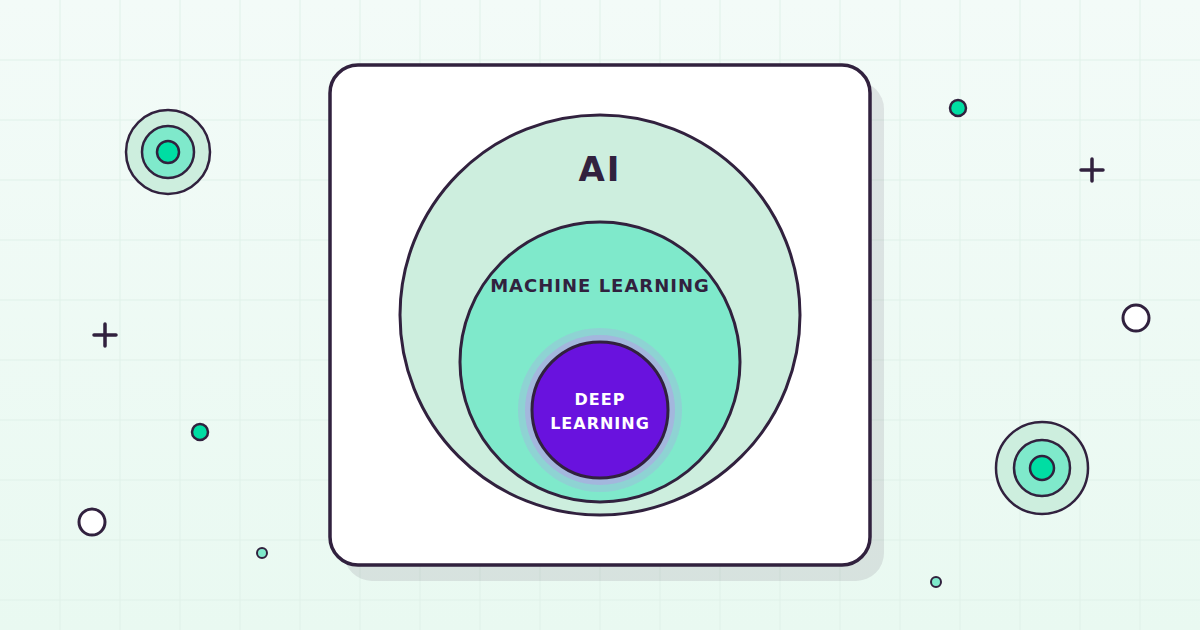
And before we go further, one picture to keep in your head, because it clears up most of the confusion in articles about artificial intelligence in finance: deep learning is a subset of machine learning, and machine learning is a subset of AI. Three nested circles. Many write-ups blur these together, and the blurring is where a lot of the hype hides.
One more thing worth being precise about, because it matters enormously in finance: these systems find statistical patterns in data. They do not reason the way people do. When a model flags a transaction as fraudulent, it isn’t suspicious of anyone – it has computed that this pattern sits far outside what it has seen before. Keeping that distinction in mind is the single best defense against both overselling AI and dismissing it.
Machine Learning
Ask a non-specialist for an example of AI and they’ll probably name a large language model or a voice assistant. Both are examples of machine learning (ML) – not the same thing as AI, but comfortably its most successful subfield.
Machine learning is the subset of AI where systems learn patterns from data instead of being explicitly programmed with rules. Nobody writes a rule that says “flag card purchases made 3,000 miles from home.” The model learns what normal looks like from millions of examples and notices when something doesn’t fit.
ML approaches mostly come in two flavors: supervised and unsupervised learning. (Some taxonomies add reinforcement learning, which is its own fascinating branch and beyond what we need today.)
Supervised learning trains on data with “features” and “labels.” The standard example is predicting house prices: number of rooms and proximity to neighbors are features, the sale price is the label. The model learns a mathematical relationship between the two, and if all goes well, it can then estimate the price of a house it has never seen.
Unsupervised learning needs no labels. It finds structure on its own – which documents use similar words, which data points cluster together. Feed an unsupervised algorithm financial data on thousands of companies and it can group them into categories nobody defined in advance. That clustering alone isn’t a trading strategy, but it can be a genuinely useful input into one.
This is the honest shape of most machine learning in finance: not a robot oracle, but a tireless pattern-finder that turns oceans of data into something a human can act on.
Deep Learning
Deep learning is a subset of machine learning built on multi-layer neural networks. The “deep” refers to those layers – each one transforms the data a bit further, letting the network learn richer and more abstract patterns than a single-layer model could.
That layered structure is why deep learning shines on complex, high-dimensional data like images, audio, and language. It’s the technology behind speech recognition, computer vision, and the large language models everyone is talking about. Modern networks can run to billions of parameters and take serious compute to train – this is generally not a laptop project.
But here’s the part that never changes, no matter how many layers you stack: a deep learning system is only as good as the data you feed it. A network with billions of parameters trained on messy inputs is just a very expensive way to be wrong. Hold that thought – it’s the through-line of this whole article.
How Is AI Used in Finance?
Finance is a natural home for machine learning: enormous amounts of data, and strong incentives to understand it well. Let’s look at where AI in finance actually earns its keep day to day.
Fraud Detection
If you want the clearest case that finance AI is real, start here. Fraud detection is one of the most mature, highest-value applications of machine learning anywhere, and every bank, card issuer, and lender depends on it – both to protect customers and to stay compliant with anti-money-laundering and know-your-customer regulations.
The pipeline runs from beginning to end of the relationship. When someone applies for a card or a loan, models help assess credit history and risk as part of underwriting. Once the account is open, fraud detection systems monitor transactions continuously, looking for anomalous patterns. If your card has ever been declined while making an unusual purchase out of state, you’ve met one of these models personally.
Under the hood it might be a neural network, an isolation forest, or a graph algorithm tracing connections between accounts. Whatever the architecture, the job is the same: learn what normal activity looks like, and flag what doesn’t fit. Notice what the model is actually doing – it isn’t “detecting a criminal,” it’s detecting a statistical anomaly, which then gets a closer look. That’s why you get a text asking “was this you?” rather than a visit from the authorities. It’s pattern recognition in service of human judgment, and it works at a scale no team of humans ever could.
Natural Language Processing
Natural language processing (NLP) is the branch of machine learning aimed at working with language. My favorite compact description: doing math with words after you’ve convinced the words to become numbers.
Unlike Python or C++, natural language is messy and ambiguous, which is exactly what made it hard for computers for so long – and exactly why the recent progress is a big deal. In finance, NLP shows up in two main places.
The first is customer service. Banks increasingly use NLP-powered chatbots to answer routine questions, which can genuinely improve the experience when done well – nobody enjoys waiting on hold to ask about a wire transfer.
The second is turning text into signals. Markets generate a staggering amount of language: news articles, SEC filings, earnings call transcripts, social posts. No human team can read it all. NLP models can – parsing that firehose into structured data like sentiment scores, topic tags, and entity mentions that quantitative researchers then feed into their analysis.
This one is close to home for us. Tiingo maintains a news database of 70M+ articles spanning 20+ years, and NLP research is one of the most common things people do with it – two decades of tagged financial news is exactly the kind of well-labeled corpus that sentiment models are built on. (It’s a ton of text.)
A word of care, though: a spike in negative coverage about a company is a fact worth knowing, not an instruction to trade. Sentiment is context, and context in markets is everything – but it’s an input to judgment, not a replacement for it.
Algorithmic and AI Trading
Among the most talked-about uses of AI in finance is algorithmic trading: using programs to execute trades automatically when defined conditions are met. The spectrum runs from simple rule-based bots (“buy when this indicator crosses that level”) to full machine-learning-driven strategies, and we’ve written detailed guides to both algorithmic trading and AI stock trading, so I won’t repeat them here.
What I will repeat, because it can’t be said enough: a model is not a crystal ball. Markets are adaptive systems full of other smart people – when a pattern gets discovered and traded on, the market itself changes, and the pattern can fade. This is a fundamental property of markets, not a flaw in any particular model.
Serious practitioners know this. They treat models as tools that need constant monitoring, out-of-sample testing, and healthy skepticism – not as money machines. Anyone selling you the money-machine version is selling the hype half of finance AI, not the real half.
FAQs About Finance AI
With the foundations in place, let’s take on some of the questions people ask most about AI in the financial industry.
How Is Data Science Different From AI?
Overlapping toolkits, different day jobs. Data science is the use of statistics and analysis to inform decisions – building the charts, dashboards, and studies that tell an organization what’s happening (how customer retention is trending, say). AI, as we’ve covered, is the broader project of building systems that perform intelligent tasks, with machine learning as its workhorse.
In practice the roles blur constantly: plenty of data scientists build ML models, and plenty of machine learning engineers spend most of their week cleaning data (a recurring theme, you may have noticed). But “we hired a data scientist” and “we deployed AI” are not the same sentence, and it’s useful to know the difference when you’re reading a press release.
How Is Blockchain Used in Finance?
This article is about finance AI, but blockchain comes up alongside it often enough to deserve a quick answer. A blockchain is a distributed ledger, usually of transactions, recorded in blocks that are chained together over time (hence the name).
In finance it shows up two main ways. First, as an approach to record-keeping and settlement – a shared ledger that participants can verify without a central intermediary, which institutions continue to explore. Second, as a data source: on-chain activity like transactions and smart contract usage is public, which makes it one more dataset that the same machine learning techniques we’ve discussed can analyze. Whether any particular on-chain signal is useful is a research question, not a given – the garbage-in, garbage-out rule applies on-chain too.
What Are Some of the Benefits of AI in Finance?
Mostly the same benefits it brings everywhere: scale, speed, and consistency. There’s only so much human attention available for answering customer questions, reading filings, and watching transactions. Machines can read every earnings call, monitor every payment, and answer questions at 3am without getting tired or bored.
That frees the humans for the work machines are genuinely bad at – judgment, creativity, and thinking about what the patterns actually mean. The best deployments of AI in finance treat it as a lever for human attention, not a replacement for human thinking.
What Is the Future of AI in Finance?
I don’t know, and I’d keep a hand on my wallet around anyone who claims they do. The trajectory seems clear enough in direction, if not in timing: models will keep taking on more of the routine, high-volume work – reading, monitoring, summarizing, flagging – and the tools will keep getting easier for smaller teams and individual developers to use. That last part genuinely excites me, because capabilities that were once exclusive to the biggest institutions keep becoming accessible to everyone.
What won’t change is the dependency underneath all of it: every one of these systems is only as good as its data.
Making the Most of Finance AI
Finance has always been an early adopter of new technology – computing, the internet, and now machine learning. From fraud detection to NLP to algorithmic trading, the real applications are real. But underneath every single one of them sits the same unglamorous requirement: clean, well-labeled data. Garbage in, garbage out. No architecture, however deep, fixes bad inputs.
That’s where we fit into this story. Tiingo doesn’t sell an AI product – we build the data layer that this work runs on, and we’ve been at it since 2014: 80,000+ assets across US equities, ETFs, mutual funds, and Chinese A-shares, end-of-day history back to 1962, real-time prices via IEX, crypto from 150+ exchanges, forex on 140+ pairs, 20+ years of fundamentals, and that 70M+ article news database – all split- and dividend-adjusted, error-checked, and served through a documented REST API.
And it’s priced so you can actually experiment with it: the Starter plan is $0, Power is $30/month, and Commercial is $50/month. We can price this way because we’ve taken no outside investment and have been profitable for 8+ years – which means we get to ask “how much can we give?” instead of “how much can we charge?” Our motto is “Actively Do Good,” and putting institutional-grade data within reach of everyone building and learning this technology is one of our favorite ways to live it.
If you’re ready to start building, create a free Tiingo account and point your models at data worth learning from. We’d love to see what you make.