
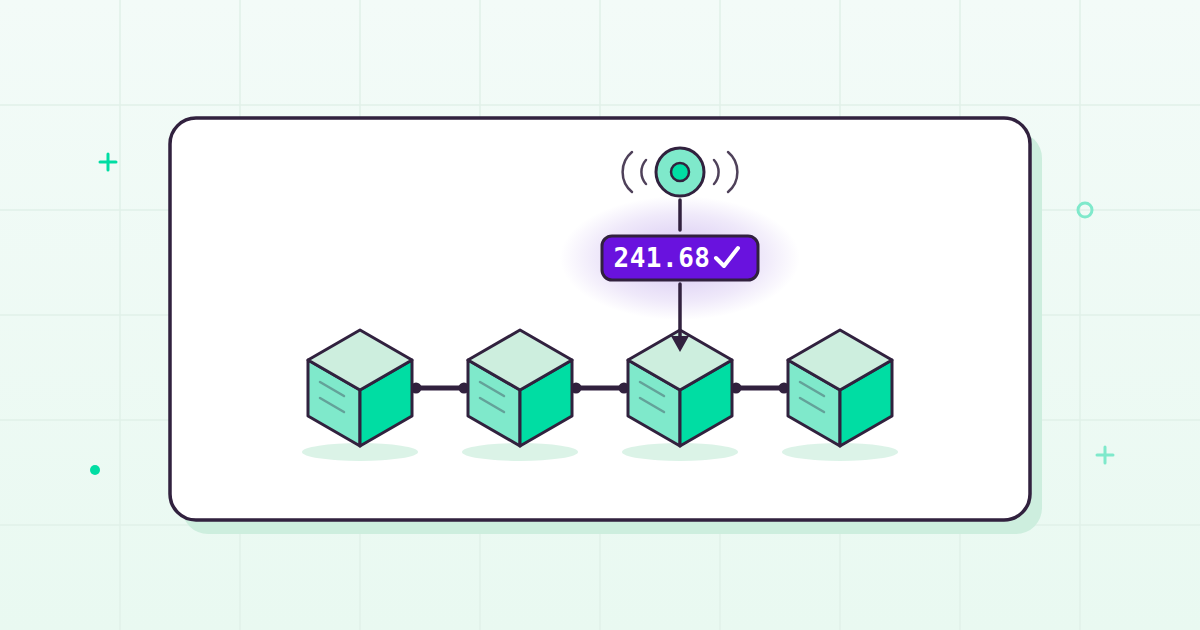
In February 2021, Tiingo launched its own Chainlink node – publishing cryptographically signed end-of-day US equity prices directly on-chain. The reason we did it is a story about market data tapes recovered after 9/11. So when readers ask us “what is Chainlink?”, we get to answer as participants in the network, not just observers of it. In this piece we’ll cover what Chainlink actually is, how a decentralized oracle network works under the hood, and how the project has grown from crypto price feeds into infrastructure that banks and asset managers are now testing.
Some quick context first. There are now blockchain networks aimed at a huge variety of use cases – money transfers, decentralized finance, gaming, logistics, tokenized funds. But different blockchains run different protocols and host different applications, and none of them can natively reach data that lives outside their own chain. Moving trustworthy information between chains, and between chains and the real world, is genuinely hard. That gap is the problem Chainlink exists to solve.
One thing this article is not: investment advice. We’re going to explain the technology. We won’t tell you what any token is worth or where it’s headed – that’s not our lane, and understanding the tech doesn’t depend on it anyway.
What Is Chainlink?
Chainlink is a decentralized oracle network (DON): open-source infrastructure that connects smart contracts to off-chain data, off-chain computation, and other blockchains.
That’s a dense sentence, so let’s unpack it.
In ancient Greek mythology, an oracle was a human with a connection to the gods – someone who could carry knowledge from a world you couldn’t reach into the one you lived in. Blockchain oracles do the same job, minus the incense. Blockchains are deliberately isolated systems: every node in the network has to agree on every computation, which means a smart contract can’t simply call an external API on its own. This is known as the oracle problem, and it’s exactly what Chainlink was built to solve.
An oracle bridges that gap. It takes real-world information – a market price, a weather reading, proof that reserves exist – and delivers it on-chain in a form smart contracts can verify and act on.
Here’s what has changed since we first wrote this article in 2023: Chainlink is no longer best described as a “price feed” network. In 2026 it’s a broad off-chain services and interoperability platform – market data, verifiable randomness, automation, serverless compute, cross-chain messaging, and institutional workflow tooling all run through the same oracle infrastructure. We’ll walk through each piece below.
And this is where Tiingo’s part of the story begins. We run our own Chainlink node – launched live in February 2021 – publishing cryptographically signed end-of-day US equity prices on-chain. That made us one of the earlier traditional-finance data providers to bring signed market data to smart contracts. It was a natural fit: our mission since 2014 has been making high-end financial data accessible to all, and putting clean, signed equity prices where smart contracts can reach them is that same mission on new rails. More on the architecture in a bit.
How Does Chainlink Work?
The single biggest misconception about Chainlink is that “a Chainlink node fetches a price and posts it.” One node doing one fetch would just relocate the trust problem – you’d be trusting that node instead of the API behind it. Chainlink’s answer is decentralization at every layer. Here’s the actual flow:
- A smart contract needs data. Say a lending protocol needs the current price of an asset to know whether a loan is properly collateralized.
- A Decentralized Oracle Network picks up the job. A DON is a committee of independent, security-reviewed node operators. Each operator fetches the data independently, and each pulls from multiple independent sources rather than leaning on a single API.
- The nodes aggregate and sign off-chain. Using Chainlink’s Off-Chain Reporting protocol (OCR), the nodes compare answers, aggregate them into one result, and cryptographically sign it – all off-chain, which keeps transaction costs down.
- One aggregated, signed transaction lands on-chain. The consuming contract reads a single value carrying the signatures of the whole committee, not the opinion of one machine.
Notice that aggregation happens twice: once at the data-source level (each node consults multiple sources) and again at the node level (the DON combines every node’s answer). Feeds then update on deviation thresholds and heartbeats – a new value is written when the price moves beyond a set band, or when a set interval of time passes.
Layered redundancy is the whole design. Individual sources can misbehave, individual nodes can fail, and the feed keeps working.
What Are Smart Contracts?
Since smart contracts are the customers of all this infrastructure, let’s define them properly.
A contract is an agreement between two or more parties that stipulates how some process should unfold. If Jackie signs a contract to write software for Joe, it lays out Jackie’s deliverables, what she’ll be paid, and what happens if either side fails to hold up their end.
A smart contract is a program on a blockchain that does the same thing in code. It says “if these conditions are met, do that,” and then it executes automatically – no intermediary, no discretion. Smart contracts power decentralized finance (DeFi) applications, blockchain games, tokenized assets, and a growing list of other things.
They’re also immutable: once deployed, the code can’t be changed. That cuts both ways. A correctly written contract will execute exactly as promised, every time. An incorrectly written one will execute its bug exactly as written, every time – which is why smart contract auditing has become a serious field, and why the quality of the data feeding a contract matters so much. A perfect contract fed a bad price will still do the wrong thing, perfectly.
Smart Contracts on Chainlink
On Chainlink, smart contracts consume oracle data in two main patterns:
- Push (Data Feeds): the oracle network writes updated values on-chain on its own cadence, and any contract can read the latest answer in a single call. Simple and battle-tested.
- Pull (Data Streams): the data lives off-chain at sub-second latency, and an application pulls a signed report on-chain at the exact moment it’s needed – say, when a trade executes. This is Chainlink’s current flagship data product, built for applications where latency matters.
Push feeds prioritize simplicity; pull streams prioritize speed. Different applications need different tradeoffs, which is why both exist.
What Exactly Does Chainlink Do?
Here’s the product lineup as of mid-2026. (If you read an older article about Chainlink, expect half of this list to be missing – the network has shipped a lot since 2023.)
- Data Feeds – the foundational product: aggregated, push-based on-chain feeds covering asset prices, reserve balances, and L2 network health.
- Data Streams – low-latency, pull-based market data delivered at sub-second speeds. The current flagship data product; as of Q1 2026 it includes 24/5 US equity and ETF streams plus 24/7 FX and commodities.
- CCIP (Cross-Chain Interoperability Protocol) – token transfers and messaging between blockchains. CCIP reached General Availability in April 2024 and has become a flagship product in its own right.
- Chainlink Functions – serverless compute that lets a contract fetch any API and run custom off-chain logic.
- VRF (Verifiable Random Function) – tamper-proof, verifiable on-chain randomness, currently at v2.5. A staple of blockchain gaming and NFT mints.
- Proof of Reserve – on-chain verification that the off-chain assets backing a token actually exist.
- Automation – decentralized, condition-based execution of contract functions (run this function when X happens, or on a schedule). If you’ve seen the name “Keepers” in older write-ups, that’s this product – it was renamed Automation in October 2022.
- CRE (Chainlink Runtime Environment) – a newer orchestration layer for building workflows that span on-chain and off-chain systems, aimed squarely at institutions.
That last item points to where Chainlink says it’s headed in 2025-2026: institutional finance and tokenized real-world assets (RWAs). At Sibos 2025, Chainlink and SWIFT announced a production rollout connecting SWIFT’s network of 11,000+ banks to blockchains via CCIP, alongside a corporate-actions initiative with DTCC, Euroclear, UBS, and roughly two dozen other institutions built on CRE and CCIP. Tokenized funds and Proof of Reserve for asset managers round out the picture. These are Chainlink’s announced milestones rather than settled history, so treat the specifics as evolving – but the direction is clear. The same oracle plumbing that priced DeFi loans is being fitted to traditional finance.
What Is the LINK Token?
Most blockchain projects have an associated token, and Chainlink’s is LINK. It’s a utility token with two jobs:
- Payment. Node operators are paid in LINK for the oracle services they provide – fetching data, running compute, delivering cross-chain messages. That payment is what makes running honest, reliable infrastructure worthwhile.
- Staking. LINK can be staked as crypto-economic security – collateral standing behind the network’s service quality. Chainlink Staking v0.2 has been live since November 2023, launching with a pool cap of 45,000,000 LINK.
LINK launched on Ethereum as an ERC-677 token (a small extension of the familiar ERC-20 standard), and today it moves across blockchains natively via CCIP.
You’ll notice what’s missing from this section: a price. That’s deliberate. We’re a market data company, so quoting one would be easy – but a price printed in a blog post goes stale the moment it’s published, and nothing about understanding Chainlink’s technology depends on it.
How Is Chainlink Different From Ethereum?
They’re different layers of the stack, not competitors.
Ethereum is a blockchain – a base layer where smart contracts live and execute. Chainlink is oracle middleware – the service layer that delivers data, computation, and cross-chain connectivity to those contracts. And Chainlink operates across many blockchains, not just Ethereum, which is exactly what you’d want from infrastructure whose entire job is connecting systems together.
A rough analogy from our corner of finance: Ethereum is the venue where the trade settles, and Chainlink is the market data line running into it. You need both, and neither replaces the other.
Who Are the Co-Founders and Leaders of Chainlink?
Chainlink was co-founded by Sergey Nazarov and Steve Ellis. The 2017 Chainlink whitepaper – co-authored with Ari Juels – framed the oracle problem and laid out the design for solving it with decentralized oracle networks.
We’ll keep this section short on purpose. Founder lore picks up embellishment as it gets retold around the internet, and we’d rather hand you three facts we’re sure of than ten we’re not.
What Is Chainlink’s Story?
The short version, in milestones:
- 2017 – the Chainlink whitepaper is published, defining the oracle problem and the decentralized oracle network as its answer.
- 2019 – the Chainlink mainnet launches, and DeFi protocols begin consuming its price feeds.
- February 2021 – closer to home: Tiingo launches its live Chainlink node, bringing signed end-of-day US equity prices on-chain.
- October 2022 – Keepers is renamed Automation.
- November 2023 – Staking v0.2 goes live.
- April 2024 – CCIP reaches General Availability.
- 2024-2026 – Data Streams matures into the flagship data product, CRE arrives for institutional workflows, and the SWIFT and DTCC initiatives are announced at Sibos 2025.
The pattern is worth naming: each phase moves Chainlink further from “crypto price feeds” and closer to general-purpose financial infrastructure.
Why Is Chainlink So Popular?
Because oracles turned out to be one of those unglamorous problems that everything else depends on. Plumbing rarely gets the spotlight. It does get used.
A few reasons the network keeps growing – described qualitatively, because adoption figures go stale fast and we’d rather skip a number than print a wrong one:
- DeFi runs on external data. Lending, derivatives, and stablecoins all need reliable prices. Chainlink’s Q1 2026 ecosystem review cites lending protocol Aave consuming its feeds and prediction market Polymarket running on Data Streams.
- Verifiable randomness is harder than it sounds. Blockchains are deterministic by design, so fair, tamper-proof randomness for games and NFT mints has to come from somewhere provable. That’s VRF.
- Trust needs verification. Proof of Reserve gives on-chain answers to “do the assets backing this token actually exist?” – a question the industry has learned to ask.
- Institutions want one integration, many chains. CCIP and CRE let banks and asset managers reach multiple blockchains without rebuilding for each one.
Where Tiingo Fits Into the Chainlink Ecosystem
We told you the beginning of this story up top; here’s the fuller version.
In February 2021 we launched a live Chainlink node publishing cryptographically signed end-of-day US equity prices on-chain, and we run it to this day. That made us one of the earlier traditional-finance data providers to bring signed market data to smart contracts.
Architecturally, our node is a different animal from the aggregated feeds described above (and we think the difference is instructive). Chainlink’s crypto price feeds are multi-node and multi-source by design – a committee vouching for a consensus value. Our node is a first-party, single-source data-provider node: we generate the end-of-day equity data ourselves, and we sign it ourselves. The signature tells you exactly who stands behind every number. Both models solve for trust; they just solve for it differently.
Why did we build it? The same reason we build everything. Tiingo has been making high-end financial data accessible and affordable since 2014 – 80,000+ assets across US equities, ETFs, mutual funds, and Chinese A-shares, with end-of-day history reaching back to 1962. Our motto is Actively Do Good, and putting clean, signed equity prices where smart contracts can verify and use them is that mission extended to a new frontier. We’ve raised no outside capital and we’ve been profitable for 8+ years, which is exactly why we can take on projects like this because they matter, not because a growth target demands them.
If you want to dig deeper, the original announcement of our live Chainlink equity price node is still up. And if it’s the underlying data you’re after, our end-of-day stock price data comes split- and dividend-adjusted, with real-time prices via IEX – the same care behind every number, on-chain or off.
Thanks for reading. If you have questions about Chainlink, oracles, or getting market data into your own project, we love hearing from our users – come find us at tiingo.com.