
An Overview of the Cryptocurrency Market
The crypto market never closes. There is no opening bell, no weekend, no holiday schedule – just a continuous stream of trades running across hundreds of venues around the world, every hour of every day. That structure changes how trading works, and it is why crypto trading strategies deserve a more careful explanation than they usually get. In a market this fast, this fragmented, and this volatile, a defined and testable approach matters even more than it does in equities – and so does the quality of the data underneath it.
Below are 13 crypto trading strategies, from moving averages (simple, approachable) to high-frequency trading (an institutional arms race). For each one: what it is, what it actually requires to run, and one honest limitation. The goal is to explain how these strategies work – not to hand you a system or tell you what to trade.
(One quick note: this article is educational, not investment advice. We are a data company – our job is to explain the mechanics clearly and let you make your own decisions.)
First, a distinction that trips a lot of people up: Bitcoin and Ethereum are assets, and the networks behind those assets. They are not exchanges. The exchanges are the venues where those assets trade – Binance, Coinbase, and hundreds of others, both centralized (CEX) and decentralized (DEX). Keeping assets and venues separate in your head is the key to understanding almost everything unusual about this market.
And it is a genuinely unusual market. Four structural differences matter most:
- It trades 24/7/365. There is no close, so there is no overnight gap and no natural pause. Volatility can arrive at 3am on a Sunday, and any strategy you run has to define when it is watching – because the market never stops being watchable.
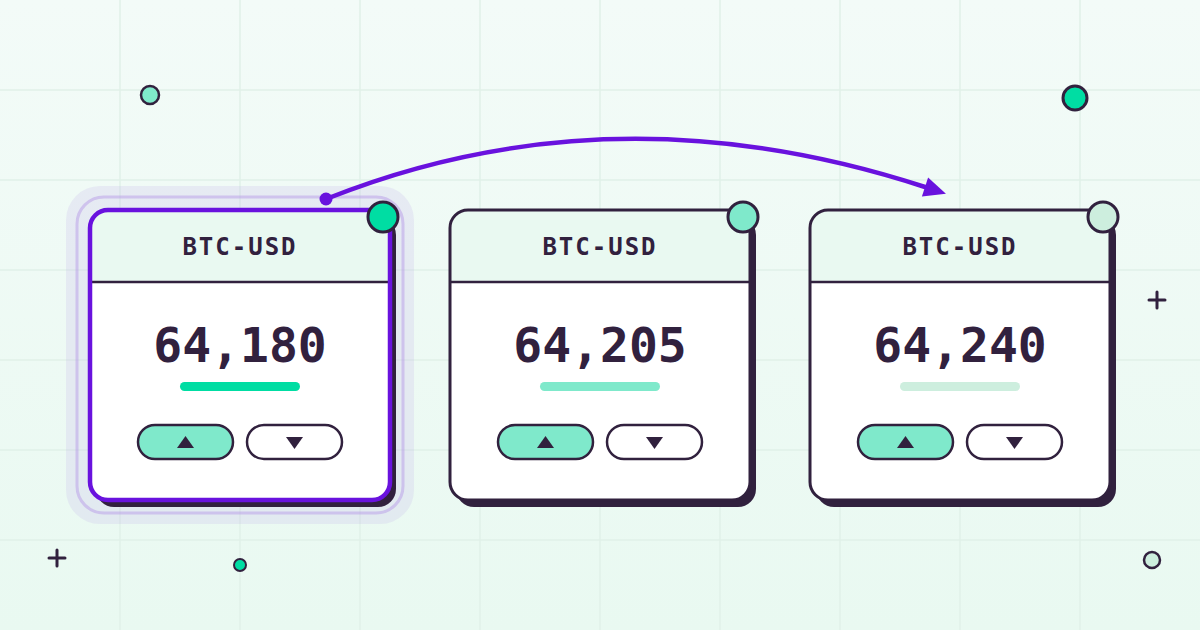
- Liquidity is fragmented. The same asset trades on many venues simultaneously, and at any given moment the price differs between them. Sometimes by a little, sometimes by enough to matter.
- There is no consolidated tape. US equities have an official, consolidated record of trades and quotes stitched together across exchanges. Crypto has no equivalent. There is no single “the price” of an asset at a given moment – only the price on each venue.
- Data quality varies enormously between venues. Some publish clean, reliable, well-behaved feeds. Others do not. Aggregate everything blindly and you inherit the worst venue’s problems.
Those four properties explain nearly everything below. Fragmentation is why arbitrage exists. The missing tape is why the venue question matters so much. And 24/7 is why automation keeps coming up.
What Are the Biggest Crypto Exchanges?
We get asked this a lot, and the truthful answer is that “biggest” is the wrong lens. Venue size is not the same thing as venue quality, and quality is what matters when your strategy depends on the prices a venue reports.
Venues vary widely in reliability – uptime, API behavior, and how faithfully their reported activity reflects real trading. At Tiingo we maintain an internal assessment of every venue we cover rather than treating them all as equal, and in that assessment Binance and Coinbase consistently rank among the most reliable. That is why they anchor much of our crypto coverage.
As for where you should trade – that depends on your jurisdiction, the assets you want, and your own requirements, so we will stay out of that decision. What we can tell you is that the venue question matters more in crypto than almost anywhere else in finance, because there is no consolidated tape to fall back on when a venue’s data goes strange.
The Main Types of Crypto Trading Strategies
Thirteen strategies sounds like a lot, but nearly all of them are variations on five families of ideas.
| Strategy family | The core idea | Examples below |
|---|---|---|
| Trend-following | Recent direction tends to continue | Moving averages, trend lines, momentum, breakout |
| Mean reversion | Stretched prices tend to snap back | Pair trading, contrarian uses of momentum |
| Arbitrage | The same asset should not have two prices | Crypto arbitrage, statistical pair trading |
| Event-driven | New information moves prices | News-based trading, sentiment analysis |
| Market-making style | Capture small spreads, many times over | Scalping, high-frequency trading |
The other axis is time horizon. Intraday approaches (scalping, HFT, most day trading) open and close positions within hours or seconds; position trading holds for months or years. Leverage and volume analysis cut across all of these – they change how any strategy behaves rather than living in one family.
With the map drawn, let’s walk through the thirteen.
The 13 Crypto Trading Strategies, One by One
1. Moving Averages
A moving average is the average price of an asset over a trailing window – 20 days, 50 days, 200 days, whatever you choose. It smooths out noise so the trend becomes visible. Traders build strategies from crossovers: price crossing above or below a long-term average, or a short-term average crossing a long-term one, is read as a change in trend.
What it requires: clean historical price data and very little else. This is the gentlest on-ramp into systematic trading, and it is where our guide to technical indicators starts too.
The catch: moving averages lag by construction – they can only confirm a trend that has already happened. In choppy, sideways markets they produce crossover after crossover, and every false signal costs a round trip of fees.
2. Trend Lines
Trend lines are the hand-drawn cousins of moving averages: support and resistance levels sketched across a chart’s highs and lows, showing where price has repeatedly stalled or bounced. Range traders buy near support and sell near resistance; others wait for a line to break and trade the break (more on that in strategy 12).
What it requires: charting tools, screen time, and judgment. Of everything on this list, this one leans most on the human eye.
The catch: trend lines are subjective. Two experienced traders can draw different lines on the same chart, and levels that look obvious in hindsight were ambiguous in real time. A strategy you cannot define precisely is a strategy you cannot honestly backtest.
3. Momentum
Momentum strategies bet that recent movement continues – an asset that has been moving tends to keep moving, for a while. Indicators like the relative strength index (RSI) quantify the speed and size of recent price changes and flag “overbought” or “oversold” readings. Some traders use those readings to ride the move; others use them to position for the pullback.
What it requires: reliable daily or intraday price history and a bit of computation. Nothing exotic – which also means plenty of competition running the same math.
The catch: crypto momentum reverses violently. An overbought reading can stay overbought far longer than a position can tolerate, and the same volatility that creates momentum trades is what ends them.
4. Crypto Arbitrage
Because liquidity is fragmented across venues, the same asset can trade at slightly different prices on two exchanges at the same moment. Arbitrage is capturing that difference: buy where it is cheaper, sell where it is more expensive, keep the spread.
What it requires: more than it appears to. You need fast execution on both venues, capital already positioned on both sides (moving funds between venues takes time, and prices move while you wait), and a full accounting of trading fees, withdrawal fees, and transfer times before you touch the trade.
The catch: those costs frequently consume the spread. A gap that looks free on a price chart often is not free once fees and transfer risk are included – and the obvious gaps close quickly, because well-capitalized firms hunt them continuously.
5. High-Frequency Trading
HFT is algorithmic trading at very short timescales – reacting to order-book changes fast enough to get there before competitors do. In crypto as in equities, this is an institutional-grade pursuit. Firms colocate servers near exchange matching engines, build very low-latency infrastructure, and employ engineering teams whose entire job is shaving time off every step of the pipeline.
What it requires: colocation, serious engineering, significant capital, and continuous reinvestment, because any speed edge decays as competitors catch up. Retail traders are not competing in this arena, and that is no knock on anyone – it is simply what the game costs to enter.
The catch: even for firms that can afford the entry fee, it is an arms race with no finish line. Understanding HFT still pays for everyone else, though – it shapes the spreads and order books that every other strategy trades in.
6. Scalping
Scalping means making many small trades to capture many small moves – dozens or hundreds of round trips a day, each aiming for a sliver of profit. Because the profit per trade is tiny, the strategy lives or dies on costs.
What it requires: venues with tight spreads and low fees, fast tooling (scalping is often automated for exactly this reason), and sustained attention. The first task is arithmetic, not analysis: fees and spread per round trip versus the average move you expect to capture.
The catch: costs dominate everything. A scalping approach that looks fine before fees can turn negative after them, and that difference is pure arithmetic, not bad luck.
7. Leverage Trading
Leverage means borrowing to open a position larger than your capital – put up $1,000 of margin at 10x and you control a $10,000 position. Gains and losses are measured against the full position but absorbed by your smaller margin, so both scale up equally fast.
The mechanic that matters most is liquidation. If price moves against a leveraged position far enough that the margin can no longer cover the loss, the venue closes the position automatically. At 10x, a move of roughly 10% against you is enough to wipe out the margin entirely – and venues close positions before losses can exceed it. That is not a warning label, just how the arithmetic works, and anyone considering leverage should be able to run that arithmetic before opening the position.
What it requires: constant monitoring, a clear understanding of the venue’s margin and funding mechanics, and an exit defined in advance – because liquidation defines one for you otherwise.
8. Position Trading
The opposite end of the spectrum: hold for months or years based on a long-term view of an asset and its network, and let the day-to-day noise wash past. Fewer decisions, less screen time, and the 3am volatility mostly stops mattering.
What it requires: a real research process for forming the long-term view, patience, and a custody decision – if you are holding for years, where the assets actually sit becomes a serious question (more on that under risk management).
The catch: crypto drawdowns run deep, and holding through them takes genuine conviction. A long horizon does not, by itself, make a thesis correct.
9. Sentiment Analysis Trading
Sentiment strategies mine social media, forums, and news for the market’s mood, on the theory that crowd emotion moves prices before anything fundamental catches up. In crypto, where narrative drives so much of the flow, the appeal is obvious.
What it requires: text data pipelines, natural-language tooling, and a method for turning noisy chatter into something you would actually trade on. This is closer to an engineering project than a chart pattern.
The catch: social sentiment is easy to manufacture. Coordinated groups can and do generate exactly the kind of spike a sentiment model is built to detect – which means the signal you found may have been placed there for you to find.
10. News-Based Trading
News trading reacts to discrete events: regulatory announcements, exchange listings, protocol upgrades, security incidents. Crypto is unusually sensitive to headlines, and because the market trades 24/7, news that breaks outside anyone’s business hours starts moving prices immediately.
What it requires: a fast, reliable news feed and a plan written before the event. Deciding what a headline means while it is actively moving the market is the hardest possible version of the job.
The catch: by the time a headline is public, algorithms have already parsed it. And second-hand “news” circulating on social media carries the same manipulation risk as sentiment (see strategy 9) – verify the source before the trade, not after.
11. Crypto Pair Trading
Pair trading trades the relationship between two related assets rather than either one outright: long the one that has lagged, short the one that has led, betting that the spread between them narrows back toward its historical pattern. It is a classic statistical-arbitrage idea imported from equities and FX, and it can be roughly market-neutral – you care about relative movement, not overall direction. (The classic crypto example is the ETH/BTC pair, which trades as its own market on many venues.)
What it requires: clean historical data on both assets to establish the relationship, ongoing monitoring of the spread, and a venue that lets you short one leg.
The catch: a correlation is a description of the past, not a promise about the future. Related assets can decouple, and when they do, a “market-neutral” trade can lose on both legs at once.
12. Breakout Trading
Breakout traders wait for price to push through a defined support or resistance level, then enter in the direction of the break – the logic being that a level which finally gives way releases stored momentum. Volume confirmation (next strategy) is often used to separate real breaks from head fakes.
What it requires: predefined levels, resting orders, and the discipline to take the planned exit when a breakout fails rather than waiting for it to “come back.”
The catch: false breakouts are common, and a 24/7 market makes them stranger – a level can “break” during thin overnight liquidity and fully reverse by morning. Which is a good reason to care about volume.
13. Volume Analysis Trading
Volume analysis uses trading volume to judge the conviction behind price moves. A rally on heavy volume reads as broad participation; the same rally on thin volume reads as fragile. Traders use volume to confirm trends, spot divergences, and flag potential reversals.
What it requires: per-venue volume data, and a view on which venues’ volume you trust. Reported volume is only as honest as the venue reporting it – which is exactly why we assess venue reliability instead of blending every feed together and hoping.
The catch: volume rarely stands alone. It is a confirmation tool that sharpens other strategies more than a complete strategy by itself – which, in fairness, is true of a lot of technical analysis.
Automating Crypto Trading Strategies with Clean Data
Run any of these strategies seriously and you discover the same thing: it is a data problem wearing a trading costume.
You need two halves. Clean historical data to test on – across the venues you actually care about, because a backtest built on one venue’s prices tells you about that venue, not the market. And reliable live data to run on, because an automated strategy is only ever as good as the feed it reacts to. (We wrote a full walkthrough of the testing half in our guide to backtesting – the discipline carries straight over to crypto.)
This is the part Tiingo was built for. Since 2014, our mission has been making high-end financial data accessible and affordable to everyone – our motto is “Actively Do Good,” and pricing institutional-grade data at these levels is what that looks like in practice. Our Crypto API aggregates data from over 150 crypto exchanges, covering both centralized (CEX) and decentralized (DEX) venues natively, with 4,100+ crypto tickers. And because venues are not equally trustworthy, we lean on our internal reliability assessment rather than blending everything indiscriminately – Binance and Coinbase anchor much of the coverage for exactly that reason.
The pricing follows the same philosophy – the question we ask is “how much can we give?”, not “how much can we charge?”:
- Starter, $0: 500 unique symbols a month, 50 requests an hour, 1,000 requests a day, 1GB of bandwidth a month. Enough to research and prototype with before a dollar is at stake.
- Power, $30/month ($300/year) for individual traders who need more room.
- Commercial, $50/month ($499/year), with a commercial-use license included.
Flat rates, properly licensed, no surprises. We can price this way because of how we built the company: not a dollar of venture funding, profitable for 8+ years. Sustainable disruption rather than growth-at-all-costs – it is why we get to put users over short-term profit.
One more practical point: the same account reaches beyond crypto. 80,000+ assets across US equities, ETFs, mutual funds, and Chinese A-shares, end-of-day history back to 1962, real-time US equities via IEX, 140+ forex pairs, and a news archive of 70M+ articles. If your strategy crosses asset classes – news-based trading and pair trading often do – it helps to have it all behind one key.
Risk Management Considerations
This is the least glamorous section of the article and the most valuable one. Every strategy above works on paper under some set of assumptions. Risk management is what decides whether you survive the assumptions being wrong.
Size positions against your total capital. The question is never “how much could this trade make” but “what happens to my whole account if it goes badly.” Sized well, no single trade can end you. Sized badly, one eventually will.
Crypto volatility is materially higher than equity volatility. An identically sized position carries meaningfully more risk in crypto than it would in equities, so position sizes need to shrink to match. If you want to put actual numbers on this instead of vibes, our guide to calculating volatility walks through the math.
Define your exit before you enter. Decisions made in advance are made calmly. Decisions made during a 3am cascade are not. Know the price at which you are wrong before the position exists.
Leverage magnifies both directions. We covered the mechanics under strategy 7, but it earns a repeat here: the same multiplier that scales gains scales losses, and liquidation is the mechanism that enforces it.
Venues are counterparties. Assets held on an exchange are exposed to that exchange – its solvency, its security, its operations. Holding on a venue is itself a position in that venue. Custody deserves the same deliberate attention as any trade.
Backtests overstate live results. Routinely. Fees, slippage, venue downtime, and partial fills rarely appear in a clean historical simulation, and all of them appear in production. Treat a backtest as an upper bound, and treat one that looks too good as a bug in the test rather than a discovery of free money (it almost always is).
The Bottom Line
Strategies are tools. None of the thirteen above is a secret, and none of them is magic. The useful question is never whether a strategy sounds clever – it is whether you can define it precisely, test it honestly, run it consistently, and afford to be wrong while you learn.
Whatever you end up exploring, start with data you can trust. The Crypto API covers what we offer, the pricing page has the full plans, and the free tier is genuinely free – test your ideas against real data before anything is on the line. High-end data made accessible to all is the whole point of Tiingo, and we would love to be the foundation under your work.